To the outside world, the war that erupted in Sudan on April 15, 2023, appeared as a sudden descent into chaos, a baffling conflict between rival generals. But for many Sudanese, it was a familiar nightmare returning in its most vicious form: the logical, brutal culmination of a system built on militarization and the violent contest for resources. To understand this war, one must reject the narrative of a spontaneous breakdown. It is instead the privatization of the state by its armed institutions, a final, devastating separation between those who wield power and those who bear its cost.
The conflict between the Sudanese Armed Forces (SAF) and the Rapid Support Forces (RSF) is not a war for Sudan’s future but a battle over the fragments of a nation exhausted by war and neglect. It is a predatory struggle over assets, territory, and networks of economic extraction, from gold mines to ports, that have long sustained these entities. As scholar Alex de Waal has detailed, Sudan operates within a “political marketplace” where loyalty is commodified and violence is the primary currency. This war is that marketplace’s ultimate expression: a violent merger-and-acquisition battle where the people are not stakeholders but spoils.
The revolution’s dream of a civilian, democratic state posed an existential threat to this system. The demand to dismantle the economics of war and subordinate the military to civilian authority directly challenged the power and wealth of the generals. The October 2021 coup was their first counter-revolutionary response; the April 2023 war is its monstrous successor. It is the sound of the deep state, in the words of researcher Kholood Khair, “eating itself,” consuming the nation in the process.
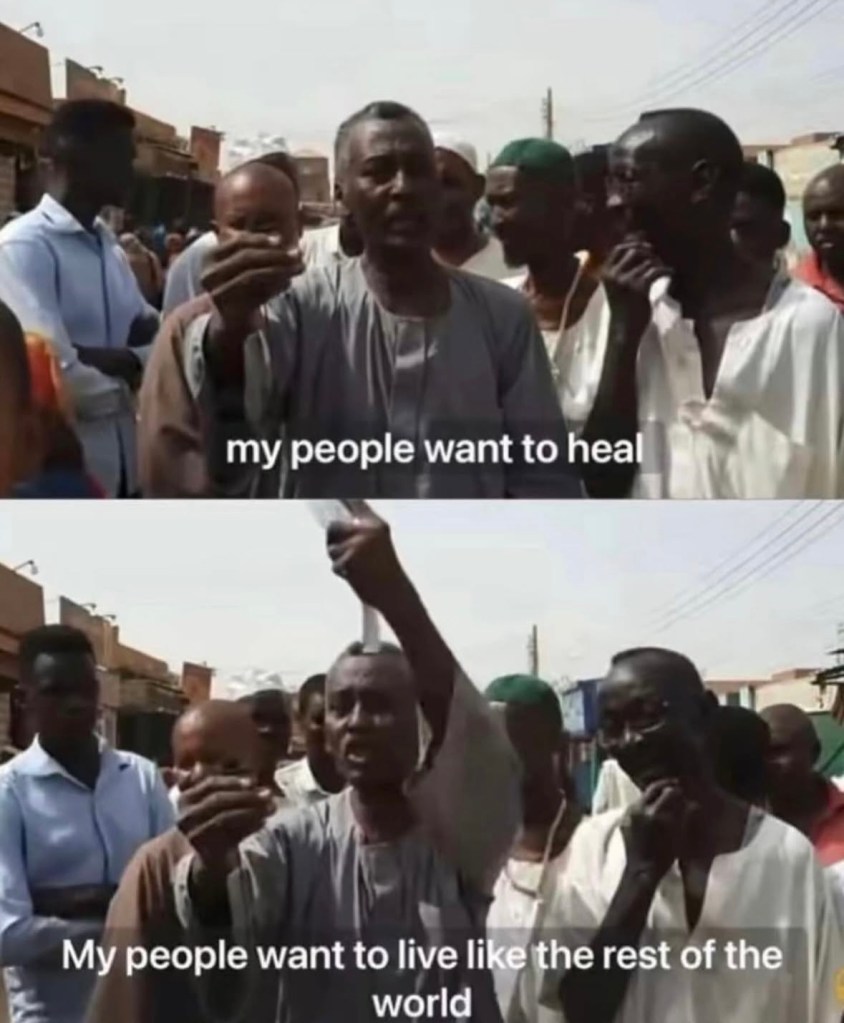
Amidst the airstrikes and devastation, a clear, defiant voice emerges from the rubble: “This war is not ours.” This statement is more than a cry of innocence, it is a political diagnosis. It marks a boundary between the people and the warring parties, a refusal to be conscripted into a narrative of tribal or ideological conflict. Across Sudan, stories of quiet defiance multiply: in hospitals lit by candlelight, in classrooms turned into shelters, and in neighborhoods where strangers share their last meal. Their struggle is not for power but for survival; not for conquest but for community.
This civilian resistance is the revolution’s legacy in its most harrowing form. The same neighbourhood resistance committees that once organized protests and built democratic practices now coordinate emergency response and mutual aid under fire. Women’s networks, once the architects of the sit-in’s logistics, now lead efforts to source and deliver medicine, organize communal kitchens, and monitor ceasefires from their homes. They embody what scholar Zachariah Mampilly calls “rebel governance without a rebel cause” creating islands of order and humanity in a sea of militarized chaos.
This war is fought over Sudan; its land, its resources, its capital, but not for its people. The gulf between the ambitions of those in power and the daily realities of ordinary Sudanese could not be wider. One side dreams of total domination; the other dreams of bread, fuel, and a future where children are neither soldiers nor victims. Between these two realities lies the quiet collapse of a promise. The revolution’s dream of peace and justice was swallowed by violence. Its call for “Freedom, Peace, and Justice” now lingers as an echo, betrayed by the very forces it sought to dismantle.
In the ruins of governance, Sudanese civilians are keeping the country alive. As the state collapses under the weight of war, communities have become their own first responders. They feed, shelter, and protect one another where no authority remains. In displacement camps, volunteers organize food rotations and informal schools; in besieged neighborhoods, youth groups coordinate safe passages and share medicine across frontlines. These acts are not merely survival; they are a quiet reassertion of political life, proof that solidarity can flourish even when power disappears.
Yet outside observers too often narrate Sudan through generals, treaties, and ceasefires, missing the real story: that life continues because ordinary people insist it must. The international gaze sees collapse, but on the ground, there is construction of trust, of care, of fragile networks of endurance. This war has revealed not only the cruelty of power but the creativity of those who live without it. The future of Sudan, if it is to exist at all, is already being built in these invisible spaces of mutual survival by the same hands that never asked for war but continue to hold the country together.
References
Abbashar, Aida. Resistance Committees and Sudan’s Political Future. PeaceRep: The Peace and Conflict Resolution Evidence Platform, 2023. https://peacerep.org/wp-content/uploads/2023/07/Abbashar-2023-Sudan-Resistance-Committees.pdf.
BBC News. “Sudan Conflict: The People Caught between Two Warring Generals.” BBC News, June 2023. https://www.bbc.co.uk/news/articles/cjel2nn22z9o.
de Waal, Alex. The Real Politics of the Horn of Africa: Money, War and the Business of Power. Cambridge: Polity Press, 2015.
Mampilly, Zachariah. Rebel Rulers: Insurgent Governance and Civilian Life during War. Ithaca, NY: Cornell University Press, 2011.
World Peace Foundation. “The Political Marketplace Project.” World Peace Foundation, 2023. https://worldpeacefoundation.org/project/political-marketplace/.
Ylönen, Aleksi. “Violent Political Transitions and State Fragmentation in Sudan.” Small Wars & Insurgencies 33, no. 3 (2022): 583–608. https://doi.org/10.1080/09592318.2022.2144000.
Africa Center for Strategic Studies. “Financial Interests of Sudan’s Generals.” Accessed October 12, 2025. https://africacenter.org/experts/financial-interests-sudan-generals/.
———. “Resetting the Political Calculus of the Sudan Conflict.” Accessed October 12, 2025. https://africacenter.org/spotlight/resetting-the-political-calculus-of-the-sudan-conflict/.
Office of the High Commissioner for Human Rights (OHCHR). “Sudan Crisis Deepens amid Rising Civilian Casualties, Growing Ethnic Violence.” September 2025. https://www.ohchr.org/en/press-releases/2025/09/sudan-crisis-deepens-amid-rising-civilian-casualties-growing-ethnic-violence.
TIMEP – The Tahrir Institute for Middle East Policy. “A Plague o’ Both Your Houses: The False Dilemma of Sudan’s Elites.” March 7, 2023. https://timep.org/2023/03/07/a-plague-o-both-your-houses-the-false-dilemma-of-sudans-elites/.
 KutubوKalam
Leave a comment