The revolution’s greatest triumph was also its most perilous turning point. The toppling of Omar al-Bashir in April 2019 was a moment of ecstatic, collective victory, a proof of power that belonged to the multitude in the streets. But what happens the morning after a revolution? When the barricades are cleared and the chants fade, the struggle inevitably shifts from the open, fluid space of the square to the closed, rigid corridors of power. This transition, from leading the streets to losing the political seats, marks the moment a revolutionary spirit confronts the sobering mechanics of statecraft.
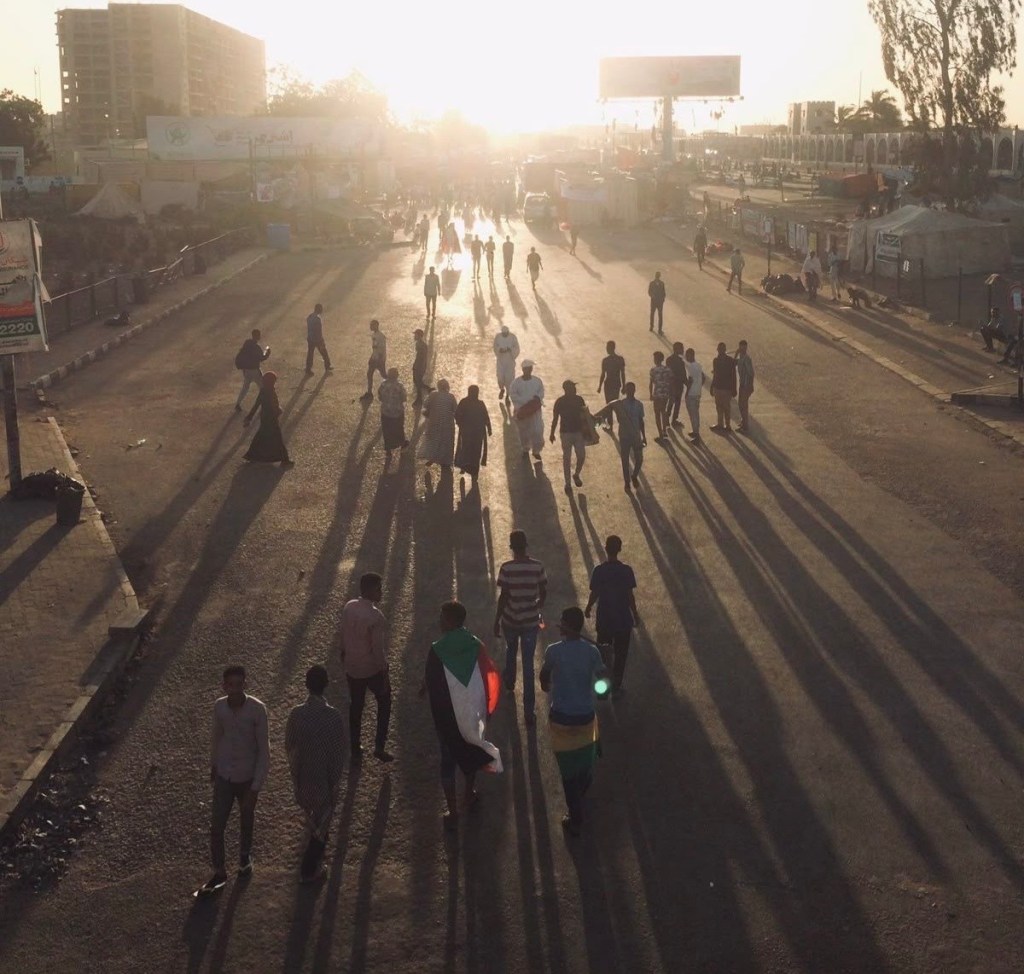
Protesters walking toward the Khartoum sit-in site during Sudan’s 2019 revolution. Photo source unknown.
The Forces of Freedom and Change (FFC), the broad coalition that gave a political voice to the sit-in, found itself thrust into a role it was never designed for: administrator. Its strength lay in its diversity and its power in its connection to the street. It was a magnificent vehicle for dissent, a chorus of countless voices united by a single goal: “Tasqut bas.” But governing requires not a chorus but a conductor; not a list of shared grievances, but a coherent, actionable plan for a nation in fragments.
This inherent fragmentation, with its broad tent spanning the political spectrum, proved its Achilles’ heel and left it ill-suited for the messy compromises of politics. The urgent, tangible demands of the streets: justice, peace, bread now had to be negotiated against the cold realities of a bankrupt economy, a entrenched “deep state,” and a military establishment that never truly relinquished power. The revolutionary coalition began to fray, caught between the immediate needs of the people and the protracted, often opaque, negotiations with the generals.
The language of change itself became a liability. The same slogans that mobilized millions were ineffective in drafting policy or managing international debt relief. The moral authority earned on the streets did not automatically translate into political leverage at the negotiating table. The military, a institution versed in the dark arts of realpolitik and patient maneuvering, expertly exploited these divisions. They watched and waited as the revolutionary forces struggled to build a consensus, their own unity of purpose standing in stark contrast to the FFC’s evolving internal debates.
And then came the betrayal. The October 2021 coup was not merely a military power grab; it was the logical conclusion of this imbalance. It was a stark lesson that the generals had only been playing for time, waiting for the public’s revolutionary fervor to wane and for the political alternatives to collapse under their own weight. The FFC, and the revolutionary movement it represented, found itself outmaneuvered. It had “lost the seats” before many of them were ever truly won.
This is not just a story of political failure. It is a deeper story about the nature of revolution itself. It reveals the fundamental mismatch between the power to disrupt and the power to govern. The streets operate on a logic of purity and absolute demands; politics demands compromise and incrementalism. The tragedy of Sudan’s transition is that by the time the revolutionary forces began to learn this new language, the space to speak it had already been violently closed.
“The power to disrupt is not the power to govern.”
The question that lingers is not just who lost the seats but whether the existing seats, the very structures of the old state, can ever be capable of holding the revolutionary future that was imagined in the streets of Atbara and the squares of Khartoum. The answer may determine whether the next chapter is one of reclaiming those seats, or of building entirely new ones.
References
ACLED (Armed Conflict Location & Event Data Project). Appetite for Destruction: The Military Counter-Revolution in Sudan. October 2021. https://acleddata.com/report/appetite-destruction-military-counter-revolution-sudan.
BBC News. “Sudan coup: World Bank suspends aid after military takeover.” BBC News, October 28, 2021. https://www.bbc.co.uk/news/world-africa-59066654.
C4ADS. Breaking the Bank: How a Militarised Financial Regime Stifles Sudan’s Transition. Washington, DC: C4ADS, July 2022. https://c4ads.org/reports/breaking-the-bank.
Freedom House. “Civic Mobilizations in Authoritarian Contexts: The Case of the 2018–2019 Revolution in Sudan.” Freedom House, 2022. https://freedomhouse.org/report/special-report/2022/civic-mobilizations-authoritarian-contexts/sudan-summary.
Makawi, Raga, and Justin Lynch. Sudan’s Unfinished Democracy: The Promise and Betrayal of a People’s Revolution. London: Hurst, 2022.
Pan African Music. “Gidam – Drums of Protest in Khartoum (Sudan 2021).” YouTube video, posted [February 18th, 2022]. https://www.youtube.com/[…].
 KutubوKalam
Leave a comment